Newsletter No. 1: A presentation on the importance of digital privacy
This was originally published on Ko-fi.
A friend and I recently gave a talk about digital privacy to the members of a mask bloc that we’re a part of. If you haven’t heard of mask blocs, they’re basically mutual aid collectives who give away respirators (N95s or KN95s or equivalent standards) for free to help protect people from COVID and other airborne diseases. They may also distribute COVID tests, drug tests, zines, and all sorts of harm reduction kits!
We wanted to talk about digital privacy because surveillance has a huge impact on our work as a collective. The smallest amount of resistance against the state can end up putting people at risk. See how easily Google gives out people’s data to ICE:
In September 2024, Amandla Thomas-Johnson was a Ph.D. candidate studying in the U.S. on a student visa when he briefly attended a pro-Palestinian protest. In April 2025, Immigration and Customs Enforcement (ICE) sent Google an administrative subpoena requesting his data. The next month, Google gave Thomas-Johnson’s information to ICE without giving him the chance to challenge the subpoena […]
Google gave IP addresses, physical address, other identifiers, and session times and durations to ICE. It doesn’t sound like much but:
But taken together, these fragments form something far more powerful—a detailed surveillance profile. IP logs can be used to approximate location. Physical addresses show where you sleep. Session times would show when you were communicating with friends or family. Even without message content, the picture that emerges is intimate and invasive.
And they can arrest you for the most basic shit and use it as evidence. Take the Prairieland Case for example:
The DOJ claims that the defendants are part of a violent ideological movement they call “antifa.” As evidence they cite zines, political rhetoric, and many practices common for activists such as using Signal, wearing black, and asserting their rights when arrested. They also use as evidence the printing press found in 2 defendants’ garage, which they used to print books for small left-wing presses.
People understand how important digital privacy is, but a lot of it is invisible, and it can be very daunting to figure out where to even begin. Of course, digital privacy won’t stop them from oppressing us, but we can make it a bit harder for them to surveil us.
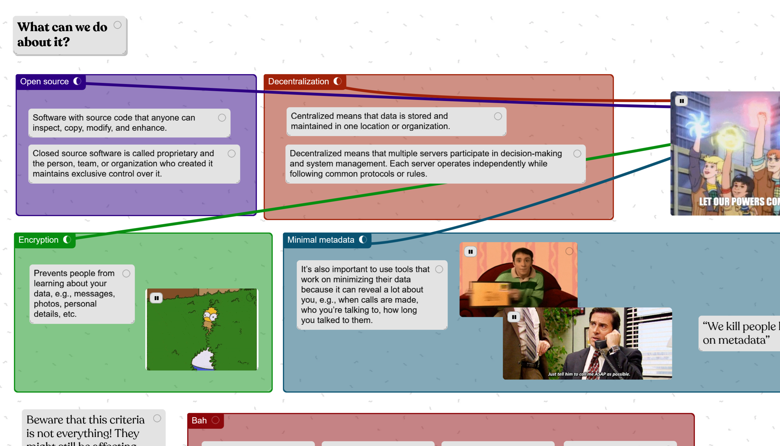
So! We had a short talk, and you can view the presentation yourself as well.
Of course, the discussion doesn’t end here! Digital privacy is hard to grasp, and technology changes quickly. Plus, changing tools is hard! So we’ll be supporting members of the collective as much as we can.